granite
Granite is another highly durable home decorating material. Its resistance to scratches and heat makes it a popular choice for areas with heavy use, such as kitchen countertops, interior and exterior flooring. Typically, the patterns of granite are consistent throughout the slab, but some very exotic types may have more varied patterns.
Siamtak Granite imports various types of granite from around the world to provide Thai consumers with a wide selection for beautiful home decoration at the most affordable prices in the world


MONALISA


VERDE LAPPONIA

BURGUNDY GOLD

BAHAMA GOLD

COSMOS GOLD

MILLENNIUM CREAM


What is granite?
The origin ofgranitecomes from igneous rock, which is formed from molten lava that cools and crystallizes under immense pressure beneath the Earth's crust. This process results in rocks composed of large mineral crystals, like granite. The mineral composition of granite consists of a minimum of 20% quartz and 35% feldspar, while the remaining proportions can be composed of other minerals. This is the underlying reason why granite is a strong and durable rock.
Granite is well-known for its durability and beauty. It's a widely used building material for both interior and exterior design. Its high resistance to scratching, burning, and stains makes it ideal for countertops, kitchen surfaces, interior walls, and other installations
Granite comes in a wide variety of colors and patterns, making it a distinctive and popular choice for both residential and commercial projects
Where can granite be installed?
Key Features: Natural granite is extremely strong and highly scratch-resistant, practically leaving no marks even from sharp objects like knives.
Installation Areas: Suitable for both interior and exterior installations, especially in areas requiring high strength or heavy use.
Popular Applications
: - Granite walls
- Thai kitchen countertops
- Stairs
- Utensils such as mortars are commonly made from granite.
What are some popular types of black granite?
Black granite with mineral flake patterns - African Black Granite / Chinese Black Granite / Indian Black Granite / Black Galaxy Granite (with gold flakes) / Thai Black Granite / Golden Black Granite
Black granite with veining patterns - Black Cosmic granite / Thaitanium gold granite / Eclipse granite / Bianco Black granite / Mistique Fire granite / Matrix granite
Why is the granite at Siamtak so cheap?
Siamtak is a granite and marble supplier that imports its own stone from around the world and owns a large-scale manufacturing facility. This allows Siamtak to control production costs from upstream to downstream, resulting in lower prices for granite, with starting prices as low as 599 THB per square meter
Read more articles about marble, granite, and other types of stone here.
About granite
Formed over millions of years through the slow cooling and crystallisation of molten magma beneath the earth’s surface, granite is one of the most durable and enduring natural stones used in architecture and interiors. As the magma cools gradually deep underground, individual mineral crystals have time to develop into a dense, interlocking structure. This geological process gives granite its characteristic crystalline appearance, exceptional strength and long-term durability.
Composed primarily of quartz, feldspar and mica, granite often contains trace minerals such as amphibole, hornblende, biotite and iron-bearing minerals, each contributing to its distinctive colour, crystalline texture and natural variation. The proportion and distribution of these minerals determine the character of each granite, producing a remarkably broad spectrum of appearances ranging from clean whites and soft greys to warm beiges, dramatic blacks, deep greens, rich reds and striking blues. Unlike marble, whose movement is typically created during metamorphism, granite derives its visual character from the size, colour and arrangement of individual mineral crystals formed as the magma slowly solidified.
On the Mohs hardness scale, granite typically measures around 6 to 7, reflecting its quartz-rich composition. Its density generally ranges from approximately 2.6 to 2.8 g/cm³, equivalent to around 52–56 kg per m² at 20 mm thickness, while its porosity is generally lower than that of many marbles, although this varies between individual granites and surface finishes. Its high hardness provides excellent resistance to scratching, abrasion and everyday wear, making granite particularly well suited to demanding environments.
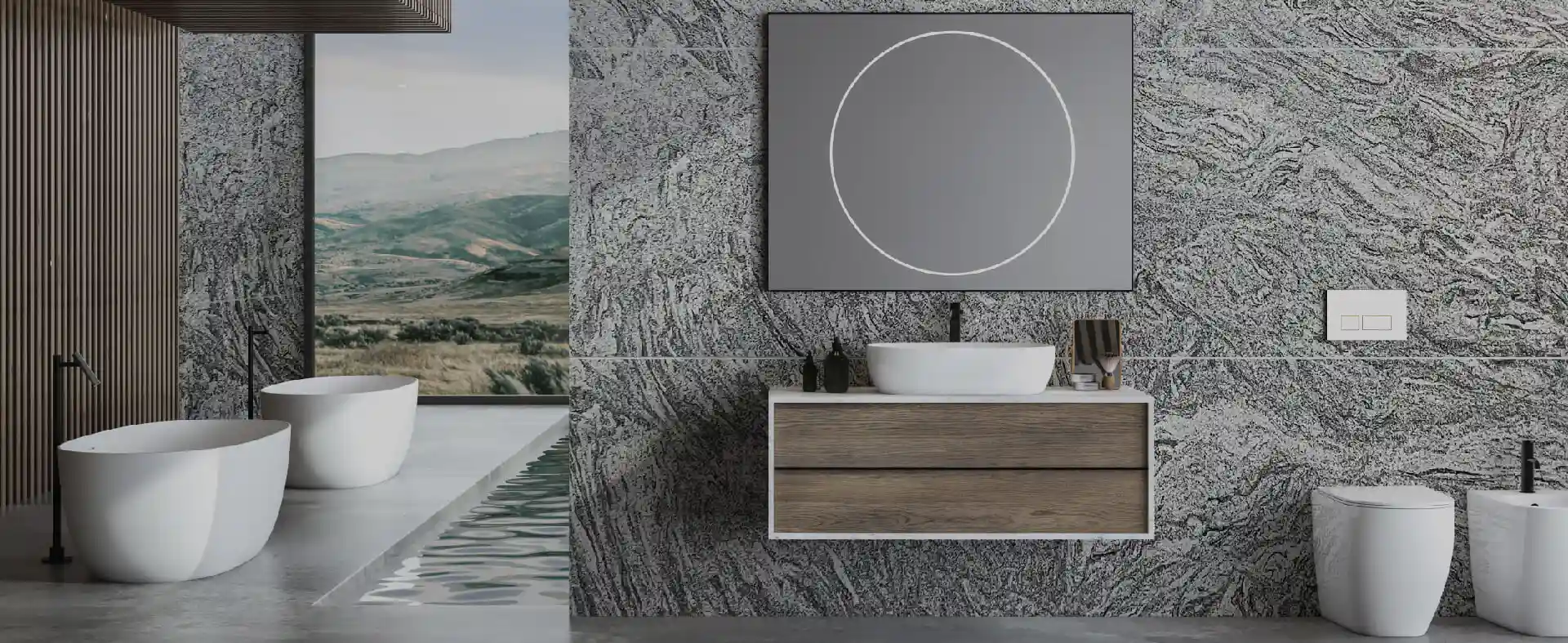
Renowned for its durability as much as its natural beauty, granite has been used for centuries in monuments, temples, civic buildings and contemporary architecture. Its crystalline depth, broad colour palette and exceptional resilience make it suitable for kitchen countertops, bathroom surfaces, flooring, staircases, exterior paving, façades, furniture and other architectural applications where long-term performance is essential.
Yet despite its strength, granite remains a natural material. Each slab possesses unique geological characteristics that should be carefully considered during selection, fabrication and installation. Mineral composition, crystalline structure and natural fissures vary from one block to another, influencing both appearance and fabrication. With thoughtful specification and proper care, granite offers an enduring balance of structural performance, natural character and timeless architectural appeal.
How granite and marble differ
Granite and marble are natural stones formed by different geological processes. Granite belongs to the igneous rock group. Marble is a metamorphic stone formed when limestone changes under heat and pressure. This distinction helps explain their general character, but the family name alone is not enough to decide whether a particular product suits a particular application.
Granite commonly has a granular or crystalline structure, while marble often shows mineral veining and colour movement created during metamorphism. Stones within the same family can still differ in mineral composition, structure, porosity, strength, finish and behaviour in use. Compare the reviewed information and full-slab images for the actual product being considered. See further options on the Marble page.
Product selection checklist
- Define whether the surface is indoors or outdoors and its exposure to sun, rain, water, staining and abrasion.
- Identify the application, such as a wall, floor, stair, counter, furniture surface or decorative element.
- Review the selected product’s stone type, finish, available dimensions and thickness, and care guidance.
- Inspect full-slab images and review the actual slab’s colour, pattern and natural characteristics before confirmation.
- Confirm installation and maintenance details with a specialist for the actual site conditions.
To compare stones for your project, contact the Siamtak team with the application, approximate dimensions, preferred finish and site conditions.
© 2026 Siamtak Company Limited. This datasheet is Siamtak's copyright.